
BIODIESEL is produced from a wide range of feedstocks, including waste vegetable oils and used cooking oil, all of which are efficiently and effectively recycled, enabling us to position ourselves as a benchmark for sustainable biofuels with high valorisation potential within the European Union. We apply advanced technology to these waste materials and residues to manufacture a high-quality finished product.
Biodiesel can be blended with diesel derived from crude oil refining in different proportions. Abbreviated designations are used according to the percentage of biodiesel by volume in the blend: B100 when using 100% biodiesel, or other designations such as B7, B10, B15, B20, B30 or B50, where the number indicates the percentage of biodiesel by volume in the blend with conventional diesel.
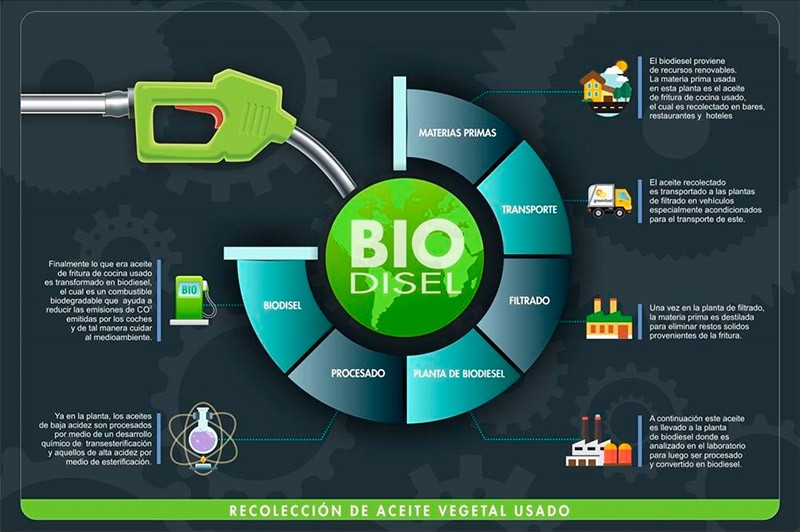
LIFE CYCLE OF USED COOKING OIL
Advantages of an Eco-Friendly Fuel: Biodiesel
Biodiesel is an environmentally friendly fuel that, because it contains no sulphur, generates significantly lower pollution than conventional fuels. It has been shown that, during combustion, its pollutant emissions can be around 55% lower than those of conventional diesel. One of its main advantages is its contribution to reducing net CO₂ emissions and, consequently, its impact on the greenhouse effect. Furthermore, biodiesel does not contain polycyclic aromatic hydrocarbons, which are known carcinogens.
Another added benefit of biodiesel is that it enables the recovery and recycling of a highly polluting waste product: used cooking oil. This waste would otherwise often be discharged through drains and eventually reach our oceans, seas, rivers, lakes and other water bodies. It is important to remember that one litre of oil can contaminate up to 1,000 litres of water.
In addition, biodiesel can help significantly reduce dependence on petroleum-based energy, as its raw materials can be sourced from renewable and recyclable resources. This contributes to greater security of supply and reduces reliance on external fossil fuel sources. Biodiesel also has a higher flash point than conventional diesel, providing greater safety during storage, handling and in the event of an accident, as it requires higher temperatures to ignite.
Finally, biodiesel offers additional benefits for vehicles. As it is derived from vegetable oils, it has excellent lubricating properties, which can contribute to improved engine performance and reduced wear. Its use can therefore help extend engine life while reducing the environmental impact associated with conventional diesel fuels.

Biodiesel offers a wide range of benefits, including:
- Requires no significant modifications for use in conventional diesel engines.
- Produced from vegetable oils, which are renewable and sustainable feedstocks.
- Enables agricultural countries to reduce their dependence on oil-producing countries.
- Provides excellent lubricating properties and helps minimise engine wear.
- Produces lower levels of harmful gaseous emissions during combustion.
- Delivers engine performance comparable to petroleum-derived diesel.
- Can be used in blends with conventional diesel at different proportions.
- Has little to no impact on engine torque or fuel consumption.
- Significantly reduces visible smoke during engine start-up.
- Is highly biodegradable, with biodegradability comparable to that of dextrose.
- Offers safer transportation and storage due to its high flash point.
- Has been successfully tested and used in Europe for more than 25 years.
- Contains no sulphur and is compatible with catalytic converters.
The lower combustion emissions of biodiesel make it an attractive alternative for cities facing severe air pollution problems and for environmentally sensitive areas, such as National Parks.
Extensive testing carried out worldwide with this biofuel demonstrates that biodiesel is competitive with conventional diesel and represents one of the most viable alternatives in the field of renewable energy.
TECHNOLOGY
At Atlantic Biofuels, we have state-of-the-art equipment and technology considered among the most advanced in the world. This enables us to process a wide range of feedstocks derived from other production processes, including oleins and fatty acids generated through chemical or physical refining, used cooking oils collected from food-service operations, Category 1 animal fats and other vegetable-based waste materials.
To process these types of feedstocks, our plant is equipped with a dedicated pre-treatment system that conditions and prepares residual oils before they proceed to the subsequent reaction stages.
Another key objective is to achieve a high level of competitiveness through research and development, enabling us to offer a product whose characteristics meet the needs and expectations of our customers. At the same time, we are committed to continuously improving our quality management system, providing a framework for ongoing improvement and ensuring compliance with all applicable legal and sustainability requirements.